
Nice Pull
What most of us want is to be the man others lean on. What we were taught disqualifies us from it.

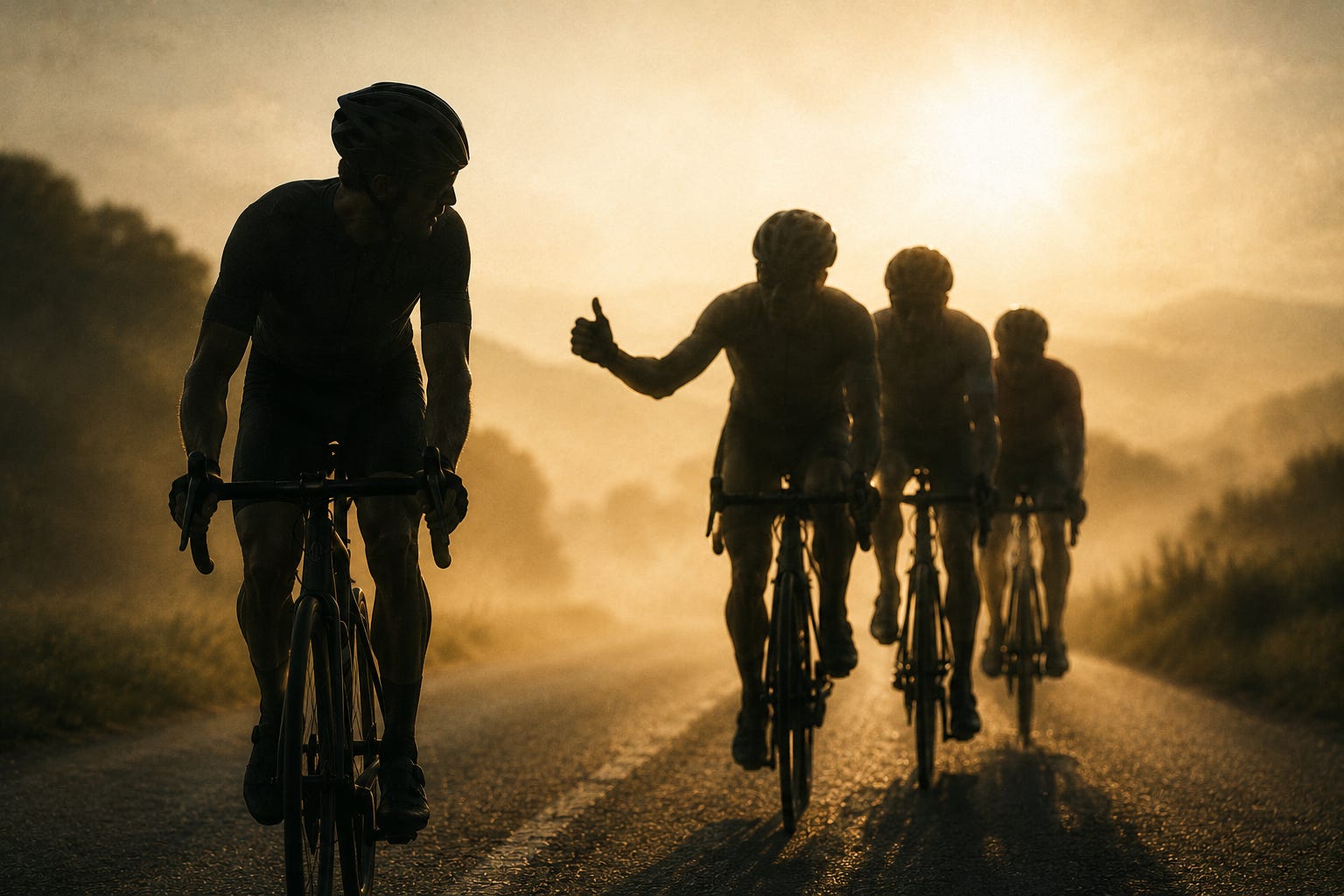
Author’s note: This is the third entry in a series about the dynamics of joining. Why men resist connecting with other men, what actually gets us across the line, and what we find when we do. It’s the natural next question after onlyness: if so many of us are carrying the same things alone, why is it so hard to stop?
I take my turn at the front and hold it as long as I’ve got. Everybody behind me is sitting in the hole I’m punching through the air, going the same speed for less. For those few minutes the whole group is depending on me, and nobody says a word about it.
Then I’m done. I swing off, drift down the line, and as the others come by, somebody says it — quietly, not looking at me, almost under his breath.
Nice pull.
Two words. Every one of us wants to hear them, and not one of us would say so out loud.
That’s how a peloton works. A man goes to the front and works harder than he would alone so that everyone else can work less. When he’s spent, he drops back and gets carried for a while, and someone else goes up and does it for him. Over and over, all day. We pull, and we count on other men to pull.
And the result isn’t just that we get there faster. We get there faster and feel stronger at the end than we did riding alone — because every man in that line has been the one leaned on and the one doing the leaning, several times over, before lunch.
That’s a kind of strength no man builds alone.
A few years ago I ran a study for a men’s organization. I asked all sorts of probing questions most of these men hadn’t really thought about. In one exercise I asked them to pick three words that describe the man you are, then three that describe the man you’d like to be.
The first lists were full of words a man can be entirely by himself. Problem solver. Deep thinker. Self-made. Achievement-oriented. Toughing through it. Alone.
The second lists were almost entirely words that require other people to be true. Respected. Connector. Leader. Giver. One of the guys.
One man — twenty-something, sharp — noticed it about his own answers and said it better than I could. Every word on his second list, he said, describes a relationship between two people. Magnetic to someone. Interesting to someone. Respected by someone. And every word on his first list, he pointed out, he could have without ever really engaging with another human being. He called that guy a sensitive observer.
Then I asked them to name the two men. The current selves came back as Prototype. Work in Progress. Loner. Wallflower. Responsible Citizen. Doer. One man, raised to depend on nobody, titled himself The Man Who Will Die Before Asking for Help.
And the aspirational selves came back as Friend. Confidant. Sounding board. Thriver. The man others come to.
Read those two columns side by side and the finding is hard to miss. Not one of those men said he wanted more support. Every one of them wanted to be the one somebody else leans on.
That’s what I think most of us actually want. Not company. Not to be taken care of. To be useful — to be the guy taking his turn at the front, and glad of the break when somebody else goes up.
But in life, most of us are riding alone. We don’t know how to operate as a peloton. The fear of revealing weakness — the one baked into how we learned to be men — is what stops us.
I interviewed a guy last year with the best group of male friends I’ve come across in hundreds of interviews. Same six men since sixth grade. Group chats, a cruise every year, flying to Barcelona for one of their weddings.
He told me nobody wants to be the first one to start that kind of conversation. That the other guys are probably feeling the same thing. That it’s an awkward silence, so it never goes on the table.
Six men who would all be good to lean on. Not one of them being leaned on. A room full of confidants, every one of them unemployed.
And then there’s the guy who gets to the front, and instead of holding the pace he goes.
He’s not pulling anymore, he’s attacking — and the moment he does, he’s alone. He got exactly what he wanted, ahead of everybody, and ahead of everybody turns out to be the same place as by himself. He didn’t escape the group. He manufactured his own onlyness, at speed, and made every man behind him work harder to keep up.
I interviewed a man like that in the study, and he’d already worked it out on his own.
He was raised to depend on no one — a family trait. He gave himself the title: Razor-focused Man, with an amazing ability to get what he wants done and achieve his goals. At the expense, he added, of his emotional well-being.
Then he laid out what that had cost him. Personal and career decisions that wrecked the political and personal capital he’d spent years building. Debt he was still paying back. A teaching career he’d had to rebuild from the ground up. And his own diagnosis of the whole thing: he took the connections and the relationships he had for granted.
Attack, gap, blow up, ride the rest of the way in alone. He’d done it with his whole life, and he knew it.
What we call self-reliance costs more than we think, and the bill comes due exactly where we’d least choose to pay it — in what we have available for the people we’d most want to be there for.
The man we’d like to become — the one somebody calls at eleven at night, the one who pulls and welcomes the break of getting pulled along by others — that man is not built out of never needing anything. He’s built out of having gone first, at some point, with somebody, so that other men know what he’s made of and know where to bring it.
There’s no version of him we can get to alone. Not because we’re not strong enough. Because the thing we’re trying to become is made of other people and always was.
Nobody says nice pull to a man riding by himself.
Not because he isn’t working. He might be working harder than anyone — most of us are. It’s that there’s no one back there to see it, and nothing he’s doing is making anybody else’s day easier. The real cost is that all that effort doesn’t land anywhere.
We don’t have to be the strongest guys out there. We take a turn. We say the true thing first, once, to one man. Then we swing off and sit in somebody else’s draft for a while — that part isn’t the failure; it’s half the job.
And then, from somewhere behind you, quietly:
Nice pull.
Great post Jim, and such a solid analogy for life as a man.
I’ve found that being the first man to be vulnerable in a group (even a group of 2) is consistently an internal challenge to overcome, until I do it, at which point it creates the peloton where each other man feels more comfortable to be open, vulnerable and sharing…. And we all end the ride (conversation) better for it.
Nice pull, Jim. Shared with a friend who cycles.