
No Drop
Sometimes a small signal of trust is all it takes to get a man to show up.

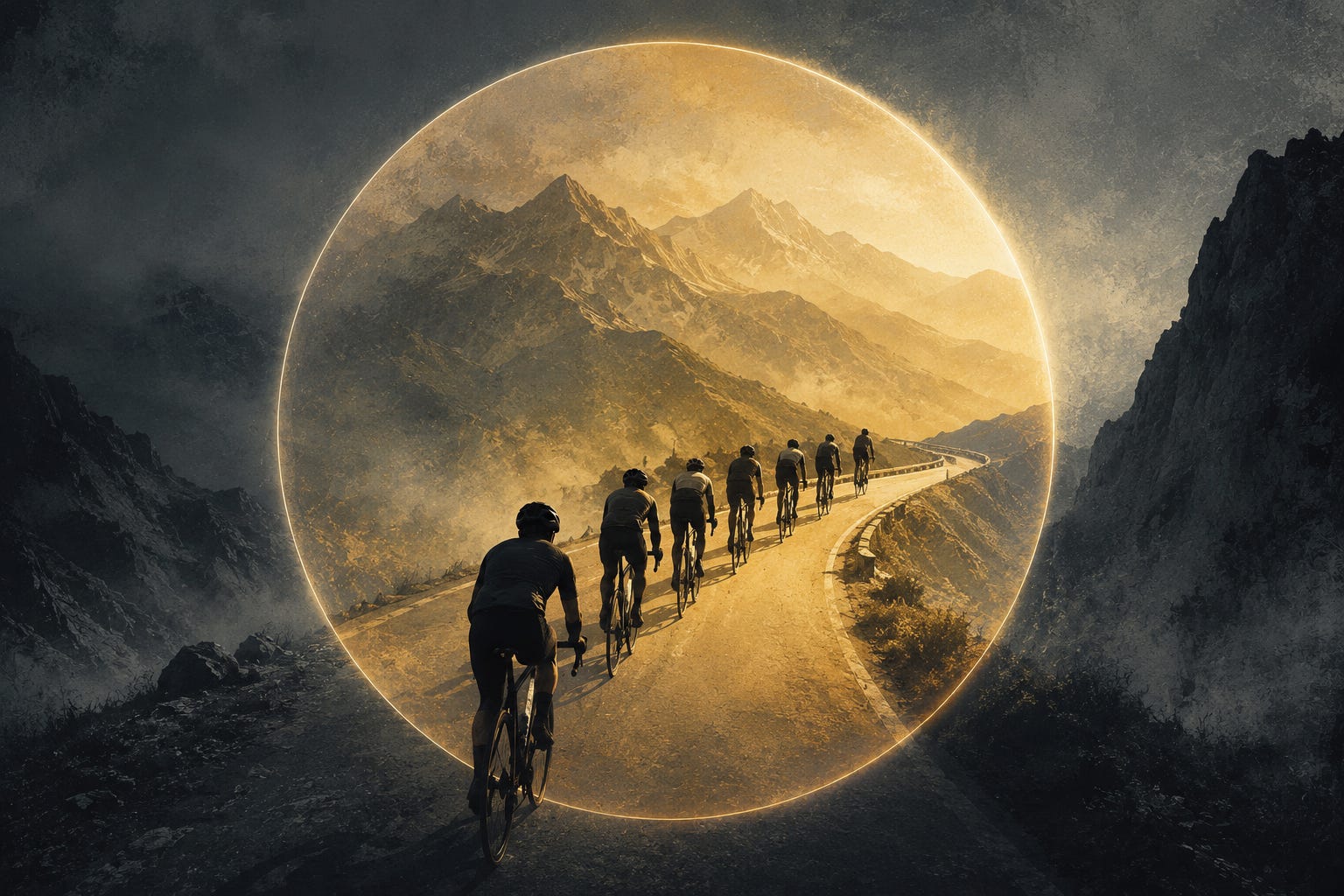
Author’s note: This is the second entry in a new series — about the dynamics of joining. Why men resist connecting with other men, what actually gets us across the line, and what we find when we do. It’s the natural next question after onlyness: if so many of us are carrying the same things alone, why is it so hard to stop?
I had bristled when Rick first asked me. But there I was anyway, in a parking lot with about twenty other guys and a couple of women, getting ready for the ride. As in most male-dominated social situations, the conversation centered on gear and the dramatic, outlandish exploits of a few of the riders. A fair share of good-natured shit-giving was in the air too, and its presence — in some ways — made me feel right at home.
The night he invited me, Rick had done something — whether he knew it or not — that made me trust him enough to show up. He’d given me a few small cues. He told me it was just one ride, no commitment. He told me it was a great group of guys, which I heard as: you’ll be accepted. And then he said the thing I now believe mattered most.
“It’s a no-drop ride.”
In cycling, that means if the group splits up, the faster riders stop at set points and wait so everyone catches up. Nobody gets left behind. Nobody ends up alone on the side of the road, gassed and humiliated, watching the pack disappear. It is, when you think about it, the ultimate assurance that weakness won’t be exposed.
I didn’t have language for why that one phrase disarmed me. I just knew it did.
Rick introduced me around, and what turned out to be his inner circle took me in fairly quickly. The trust I’d felt with him transmitted, fast, through a few of the other guys. He reviewed the no-drop gathering points, and we were off.
I can’t say anything monumental happened on that first ride. Some introductions, some easy conversation, no earth-shattering moment of insight that changed my life on the spot. What happened was smaller and, I think, more honest: I was strong enough to hang with the group’s pace. Nobody got dropped. I could already tell which of these men I wanted to know and which I didn’t. And I knew I’d come back.
What I found over the rides that followed wasn’t a sudden epiphany. It was a gradual sense of ease. I realized I could still ride alone whenever I wanted — I wasn’t losing the solitude that had always mattered to me. I was adding to it. Riding with these men was a different thing than riding alone, and I was learning what that difference was made of: what we expected of each other, how we looked after one another, things that simply didn’t come up when it was just me and the road.
Eventually I started organizing a group of about eight of us to go out to Colorado to experience the scenery, and the challenge of high mountain passes. Men who go through something physically and emotionally hard together tend to come out the other side bound to each other. We did it, and then we did it again, year after year.
A strange dynamic was always in play. We wanted to beat each other, and we wanted every one of us to make it. On some climbs I’d finish ahead of the pack. On others I’d bonk completely, cracked and crawling, and there’d be a guy waiting. The competitive fire was real. So was the certainty that nobody would be left behind. It never felt like a contradiction.
Over time, the wanting-to-win quietly gave way to something else — an appreciation for the hours we had together on the bike. We didn’t want them to end.
Here’s the part I’ve come to find remarkable. My research says this isn’t just a dynamic in cycling — it’s the sort of thing men are looking for when they join a men’s group.
I’ve participated in men’s groups run by different organizations, and I’ve watched men walk in with a particular fear in their eyes — the look that says I’m going to be expected to reveal weakness, and this isn’t going to be easy.
A while back I ran a study where I showed men descriptions of real men’s groups and asked which ones they’d want to hear more about. The group that leaned hardest into rugged masculinity — three days off the grid, get kicked in the teeth and get back up, join us and prove it — finished near the bottom. Men read “prove it” as a threat: they might not measure up, and everyone would see.
The groups that drew the most interest were the ones that promised the opposite — that performance wouldn’t be the point, that no one would be singled out as the weak one. One described itself as a place with no authority and no novice, no therapist and no patient, just men treating each other as peers, without judgment. Another simply said its men had your back.
It took me a while to see it, but those groups were all offering the same thing Rick offered me in that banquet hall. The men choosing them were looking for a no-drop ride — a place where being slower, or weaker, or less far along than the next guy wouldn’t get them left on the side of the road. Strip away the settings, the mountains and the meeting rooms and the bikes, and that’s the condition nearly every man is quietly waiting for before he’ll walk in.
We found it in our cycling group without ever naming it. And once we had it, the thing we’d been chasing — beating each other, proving ourselves — mattered less and less. What we wanted was to stay in it a little longer. Together.
One of the guys gave us the words for it, on a climb, years ago. We’ve repeated them almost as a mantra ever since — the phrase that still reminds me to stop racing toward the end of a good thing and be inside it while it’s happening.
“We’ve got all day.”
Been thinking a lot lately about being left behind, what we could call abandoned, mostly in terms of how we can self-abandon. It's easy to imagine how alluring the promise of a group that refuses to do that could feel to a man, even as he abandons himself in many aspects of his life.
The ways in which we abandon ourselves are too many to name, and this is an experience that can be felt by any human. It's not just something men experience. It just expresses differently in dudes.
We abandon ourselves for many reasons, perhaps to feel seen or loved, or avoid conflict. Over time, these abandonments stack up and make us feel unseen in general.
In men, we might see this show up as "Mr Nice Guy" behavior, where men create endless covert contracts to be the nice guy in every situation, but that's just one obvious example. What's unique to men with self-abandonment is the denial or complete unawareness that something like this is even possible (let alone happening).
For men, the stakes feel too high to even realize this is what's happening. So we double down on protector parts to cover up the vulnerability inherent in admitting the desire for our parts to feel seen.
Reading this, it's clear to this coach that this biking group seems to be tapping into this fundamentally missing need in many men's lives.
As an avid cyclist (a clydesdale no less) and an active men's group leader/member, I resonate deeply with this piece.
When I was getting back into riding a few years ago (after years of not riding) with my long-time riding group, I remember deeply how a few of the guys would actually ride back to check on how I was doing on some of the difficult ascents - and ride with me, even while I was cramping. I remember a ride last year where I was really struggling, and how the other 3 guys in that group took turns pulling me into the headwinds. And I recall other rides where I was one of the stronger riders bringing new riders into the sport -- and how I felt a responsibility for them.
There is a deep bond created when those who are stronger extend themselves to support those who are weaker, in general or just on that specific day, and I find the bond goes both ways. Obviously the man being helped gets the benefit, and joy, of being helped when it's so hard in day-to-day life to be helped. But more importantly, the men who offer the support and help, in a conscious service providing role, also get immense internal pleasure and value out of being there for other men. The bond goes both ways and is mutually beneficial.
I see this well beyond cycling - in men's groups when one of the men is struggling (as happens to all of us from time to time) and reaches out for help, which is an incredibly scary and vulnerable thing to do, how the other men circle up and step up to support that man in whatever way they can -- and it strengthens the bonds of the group.
We gotta ride sometime together!!!